
If you love RC flying, you’ve probably experienced the adrenaline of RC helicopters or the speed of fixed-wing planes. But RC paragliders offer something very different—slow, smooth, and unexpectedly relaxing flight.
Rather than sharp maneuvers and constant corrections, an RC paraglider focuses on gentle gliding and long airtime. That makes it an appealing option for backyard pilots or anyone looking for a low-stress way to enjoy RC flying without the intensity of helicopters.
What Is an RC Paraglider?
An RC paraglider is a remote-controlled aircraft designed to replicate the calm, gliding flight of a real powered paraglider. Instead of rigid wings or rotor blades, it uses a soft fabric canopy to generate lift, resulting in slower speeds and a more relaxed flying style than RC helicopters.
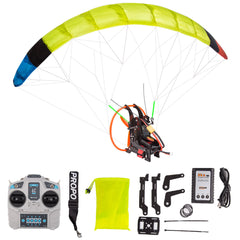
In his review of the Razordon RC Electric Stunt Mini Paraglider, YouTuber Jay Kujan highlights how approachable this type of aircraft can be. The model features a lightweight ripstop nylon canopy paired with a small electric motor and propeller, allowing for smooth, controlled flight in light wind conditions. Priced around $200, it offers a budget-friendly entry point for pilots curious about RC paragliding.

At its core, an RC paraglider mimics its full-scale counterpart. It consists of two primary components:
- The Wing (Canopy): Made from lightweight, durable ripstop nylon, the canopy forms an airfoil when inflated by airflow. Unlike rigid wings, it relies on its shape and internal cells to generate lift, contributing to the paraglider’s naturally stable flight characteristics.
- The Paramotor Unit: Suspended beneath the canopy, this unit contains the electric motor, propeller, battery, receiver, and servos. Steering inputs adjust the brake lines, controlling direction and climb rather than relying on complex mechanical systems.
Jay Kujan’s Hands-On RC Paraglider Flight Test
To understand how an RC paraglider performs in real conditions, seeing it flown by an experienced pilot makes all the difference. Jay Kujan’s test flight provides a clear look at what beginners and casual pilots can expect.
Watch Jay Kujan’s full flight test here:
One of his first impressions was how accessible the model is straight out of the box. “There is no assembly required,” Jay explains. “I literally pulled it out of the box, and this was how it was.” This Ready-to-Fly design removes much of the setup complexity that often discourages newcomers to RC flying.
While the paraglider is primarily built for calm, scenic flights, Jay also demonstrated simple aerobatic maneuvers such as back loops. These aren’t as aggressive as helicopter 3D moves, but they add variety and fun without demanding constant precision.
Flight time was another standout. Using a 3S 1500mAh battery, Jay recorded flight sessions typically ranging from 15 to 30 minutes, depending on throttle use—significantly longer than most RC helicopters. That extended airtime reinforces the paraglider’s appeal as a relaxed, endurance-focused aircraft.

The Razordon RTF Paraglider: Unboxing the Experience
So, what exactly makes the model Jay Kujan flew so accessible and enjoyable? Let's dive into the details of the Razordon RC Mini Paraglider Model and break down the key features that make it stand out as a premier beginner-ready RC glider.
Key Feature 1: Truly Ready-to-Fly (RTF)
The Razordon RC Paraglider is engineered for instant fun with no assembly required. Jay Kujan praises its simplicity: “I did nothing… it literally comes like this.” The package includes a 2.4G remote, a 3S 1500mAh battery, a charger, and spare parts like extra propellers, ensuring you’re ready to fly right out of the box.
Unlike some RC helicopters that demand complex setup, this RTF design uses a 2204 motor and 12A ESC for reliable performance, making it perfect for beginners or pilots seeking a hassle-free alternative.
Key Feature 2: Surprisingly Easy to Fly
Jay Kujan’s backyard flights highlight the RC Paraglider’s beginner-friendly design: “It’s easy to fly… I’ve flown it in my backyard.” Built from lightweight nylon and plastic, the paraglider offers both stability and responsiveness. Its advanced stabilization system keeps the flight smooth even in gentle breezes.
The 2.4G multi-channel remote and two 12G metal servos provide intuitive control, requiring only throttle and steering inputs—far simpler than the precise handling of RC helicopters.
Key Feature 3: Battery Life & Performance
Equipped with an optimized power system and a robust 3S 1500 mAh battery, this paraglider offers around 30 minutes of continuous flight—a remarkable endurance that far exceeds most similarly sized helicopters or airplanes. This long airtime creates a truly immersive, stress-free flying experience.
Powered by a 2204 motor and 5-inch 3-blade propeller, it delivers smooth glides and enough thrust for aerobatic stunts like loops and twists, which Jay tests in his review: “Let’s go back loop.”
Its advanced stabilization system ensures steady flight even in mild breezes (wind resistance level 1), though Jay advises, “Easy on the power,” to optimize performance. For extended sessions, grab a spare battery, a tip RC helicopter fans will appreciate.
Key Feature 4: The FPV Potential
Jay Kujan envisions exciting upgrades: “Put FPV head tracking on this thing… send it 400 feet up.”
The RC mini Paraglider’s lightweight frame (nylon and plastic construction) and foldable 128cm wing make it an excellent platform for adding a small FPV camera, offering immersive high-altitude views. This appeals to RC helicopter pilots who love modding for first-person experiences.
Flying Tips from Jay Kujan’s Experience
Mastering the Razordon RC Paraglider is surprisingly straightforward, but a few key insights from someone who's already flown it can transform your experience from good to great.
Here are the essential RC paraglider flying tips we gathered from Jay Kujan's hands-on experience that will help you avoid common pitfalls and ensure smooth sailing from takeoff to landing.
Choose Light Wind Conditions
Jay emphasizes flying in calm conditions: “There’s a very light wind here.” The RC Electric Stunt Mini Paraglider Model performs best in winds under 10 mph, as its 128cm nylon canopy can get tossed around in stronger breezes.
Check the weather before heading out, and pick a clear, calm day for stable glides. Unlike RC helicopters, which handle varied conditions with precise control, this paraglider thrives in gentle breezes, perfect for backyard sessions.
Master Gentle Launches
Launching is key, and Jay advises caution: “It’s okay to abort the throw… you don’t want to throw this thing into the ground.” Hold the paraglider by its base, ensuring fingers are clear of the 5-inch propeller, and toss it gently into the wind with a slight upward arc.
Jay’s backyard success shows that a smooth, low-throttle launch fills the canopy for a quick takeoff. Practice in an open space to avoid crashes, especially if you’re used to the powered launches of RC helicopters.
Control Throttle Smoothly
Jay notes a learning curve: “You have to use the throttle to adjust altitude.” Unlike RC helicopters, where throttle directly controls height, the RC Mini Paraglider Model's 2204 motor requires smooth inputs to maintain steady glides or climb for stunts like loops.
“Easy on the power,” Jay warns, as abrupt changes can cause pendulum swings. Start in low-rate mode for relaxed flying, then switch to high-rate for aerobatics, ensuring a stable RC paraglider flight experience.
Land Carefully to Avoid Tangles
Landing deserves special attention. As Jay discovered, coming in too aggressively can cause the paraglider to front-flip and tangle its lines. A gentle approach—either catching it by hand or landing on soft ground—helps avoid post-flight line management issues.
Compared to helicopter landings, the process is simpler, but patience and awareness of canopy position make a big difference.
Pack Spare Batteries
With its 3S 1500mAh battery, the RC Electric Stunt Mini Paraglider Model offers 10-30 minutes of flight time, depending on throttle use.
Jay’s field test confirms this, but for longer sessions, he implies spares are handy: “Pack a spare battery,” a tip RC helicopter pilots will recognize. Charge fully before flying and keep extras ready to maximize your beginner-friendly RC paraglider experience, especially for stunt practice or FPV flights.
RC Paraglider vs. RC Helicopter – Key Differences
For hobbyists exploring which RC aircraft suits them best, here’s a quick comparison between an RC Paraglider and an RC Helicopter:
| Aspect | RC Paraglider | RC Helicopter |
| Learning Curve | Beginner-friendly, easy to launch | Steeper, requires practice and precision |
| Flight Style | Relaxed, scenic gliding | Fast, agile, capable of 3D stunts |
| Flight Time | Up to ~30 minutes on 1500mAh battery | Shorter, typically 6–12 minutes |
| Best For | Casual flying, FPV exploration, long sessions | Aerobatics, advanced control, high-energy flying |
| Crash Risk | Lower, canopy absorbs impact | Higher, blades/gears prone to damage |
As Jay Kujan noted in his review, the paraglider offers "a relaxing flyer" experience compared to the high-intensity nature of helicopters. While helicopters excel at precision aerobatics, the paraglider shines in accessibility and endurance, providing "probably 30 minutes of flight time" on a small battery.
Is the RC Paraglider Worth It?
For many hobbyists, the biggest question before trying a new RC Paraglider is whether it justifies the investment. In the case of the Razordon RC Paraglider, the answer leans strongly toward yes—especially if you’re looking for a balance of accessibility, fun, and value.
Who will find it most worth it?
- Beginners seeking a low-stress entry point into RC flying
- Experienced pilots wanting a relaxing alternative to high-intensity flying
- FPV enthusiasts looking for a stable, long-endurance platform
- Budget-conscious hobbyists seeking maximum flying time per dollar
Priced at around $200, the Razordon RC Electric Stunt Mini Paraglider delivers exceptional value for money. It provides a unique flying experience that complements rather than replaces traditional RC aircraft.
As Jay Kujan concluded, "I think for the price, ready to fly, if you guys... like relaxing flights or even just buzzing around your backyard at low throttle, I think it's a good option."
Conclusion: Soar with Jay Kujan’s RC Paraglider
Flying an RC paraglider delivers a very different kind of satisfaction compared to helicopters or fixed-wing aircraft. Jay Kujan’s experience shows that RC paragliding isn’t about speed or constant input—it’s about smooth air, long flights, and simply enjoying the process.
For pilots looking to add variety to their RC collection or for beginners who want an approachable entry point, an RC paraglider offers something genuinely refreshing. It doesn’t replace helicopters—but it complements them in a way that feels both relaxing and rewarding.
Ready to experience it yourself? Check out the Razordon 2.4G RC Electric Stunt Mini Paraglider – RTF Version and take your RC hobby to new heights.