
Flying an RC helicopter is about more than controlling the sticks. It's also about understanding what's happening with your aircraft while it's in the air.
Have you ever experienced a sudden climb during flight and wondered whether the battery was running low? Have you watched your helicopter drift away without knowing whether it was caused by GPS signal loss or compass interference? Or noticed unusual vibrations after landing, without knowing whether something was damaged?
These are familiar challenges for many RC helicopter pilots, especially those flying GPS-equipped models.
Traditional transmitters are primarily designed to send control commands. But what if your transmitter could do more than that? What if it could tell you your helicopter's battery status, GPS information, flight conditions, and even help you investigate unexpected problems?
That's exactly what FLYWING set out to achieve with the FY-RC02 Smart RC Transmitter.

Combining 12-channel control, real-time telemetry, voice announcements, flight-log recording, and flight-controller parameter adjustment, the FY-RC02 brings multiple essential functions together in one integrated device.
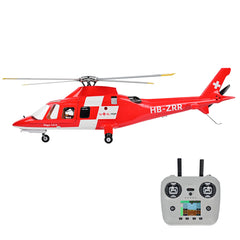
With selected new FLYWING helicopters, including the AW109, this upgraded transmitter introduces a smarter and more connected flying experience.
1. Five Common RC Helicopter Problems That Every Pilot Can Relate To
Before exploring the FY-RC02, let's look at some situations that RC helicopter pilots may have experienced.
1.1 Your Helicopter Suddenly Climbs — Is the Battery Running Low?
You're enjoying a flight when your helicopter suddenly starts climbing or behaving unexpectedly.
You look at the LED indicators, but they're difficult to read at a distance. You become nervous and instinctively reach for the throttle or motor kill switch.
One wrong reaction could turn a manageable situation into a crash.
Wouldn't it be better if your transmitter could display battery information and provide a voice warning when the battery voltage becomes too low?
Instead of guessing, you could receive useful information to help you assess the situation and make a more informed decision.
1.2 Your Helicopter Starts Drifting — Is It a GPS or Compass Problem?
Your helicopter is holding its position normally, then suddenly begins drifting.
You cannot clearly see the LED status, and you're unsure whether GPS positioning has been lost, the compass is experiencing interference, or another flight-control issue has occurred.
Without knowing what's happening, it's difficult to react confidently. Your helicopter may drift toward a tree or outside your preferred flying area.
With real-time telemetry and voice notifications, you can receive more information about your helicopter's operating status rather than relying entirely on visual indicators.
1.3 Your Helicopter Sounds Different After Landing — Is There Excessive Vibration?
Your helicopter touches down a little harder than expected.
You inspect it, restart the motor, and notice that the sound seems louder than before. It still flies, but something doesn't feel quite right.
Is there excessive vibration? Has something become loose? Is the flight controller detecting an abnormal condition?
Having access to relevant flight-controller information and vibration data, where supported, provides a better starting point for troubleshooting.
1.4 Your Helicopter Suddenly Stops Flying — What Actually Happened?
An unexpected motor shutdown is one of the most stressful experiences in RC helicopter flying.
Was the motor kill switch accidentally activated? Was there a control input issue? Did a protection mechanism intervene?
Without flight records, it can be difficult to reconstruct exactly what happened.
The FY-RC02 supports flight-log recording and playback, helping pilots review recorded flight information and investigate potential causes instead of relying only on memory.
1.5 GPS Satellites Cannot Be Acquired — Is the GPS Module Faulty?
Sometimes, a helicopter cannot enter GPS mode because the required satellite positioning has not been established.
But is the GPS module actually faulty?
The issue could be related to satellite availability, compass conditions, initialization, or another system status, including whether the motor kill switch is in the required position.
A transmitter that displays satellite information and relevant flight-controller status makes troubleshooting much more straightforward.
The common problem behind all five situations is simple: pilots need more information about their helicopters.
2. Traditional RC Transmitters vs. Smart Telemetry Control
Traditional transmitters are primarily designed to send control commands. More advanced radio systems can also offer programmable functions and telemetry, but the overall experience depends on the radio, receiver, sensors, flight controller, and configuration.
Let's look at two familiar transmitter platforms.
FlySky FS-i6S: Simple and Familiar
The FlySky FS-i6S is a familiar entry-level transmitter among RC hobbyists.
It provides basic control functionality and is suitable for many conventional RC applications.
However, in a typical basic FLYWING helicopter setup, pilots may not have access to the integrated flight-controller configuration, voice alerts, and detailed flight-status experience offered by the FY-RC02.
This means pilots may still need to rely on LED indicators or additional equipment to understand what's happening during flight.
EdgeTX / RadioMaster: Flexible but Configuration-Heavy
EdgeTX-based transmitters, including popular RadioMaster systems, offer extensive customization and programmable functionality.
Telemetry and voice announcements can also be configured when compatible hardware and data sources are available.
However, creating a complete experience may require additional configuration, telemetry setup, audio files, and programming.
For pilots who prefer an integrated experience with their FLYWING helicopter, configuring everything independently may not be the most convenient solution.
What Makes the FY-RC02 Different?
FLYWING took a different approach.
Instead of simply developing another transmitter with more channels, the goal was to integrate the functions pilots actually need into one dedicated control terminal.
-
Control your helicopter with a high-precision metal gimbal system.
-
Monitor available flight information in real time.
-
Receive voice announcements.
-
Configure compatible flight-controller parameters.
-
Record and review flight logs.
-
Manage multiple compatible aircraft.
The result is a more connected flying experience.
3. Why FLYWING Developed the FY-RC02 Smart Transmitter
FLYWING wanted to build a transmitter that could do more than send commands.
The development goals were straightforward:
A transmitter with a comfortable control feel and long operating time.
A transmitter that helps pilots understand their helicopter's status.
A transmitter that can replace a computer for compatible flight-controller setup and calibration.
A transmitter that records flight data for later review.
A transmitter that can manage multiple compatible aircraft without requiring a separate transmitter for every model.
These goals led to the FLYWING FY-RC02 Smart RC Transmitter.
4. FLYWING FY-RC02: Key Features and Specifications
The FY-RC02 is an integrated RC control and telemetry terminal designed for compatible FLYWING helicopter systems.
Main Specifications
| Feature | Specification |
|---|---|
| Channels | 12 Channels |
| Display | 2.8-inch TFT Color Screen |
| Stick Assembly | High-Precision Metal Gimbals |
| Communication Protocol | FLYWING-developed FWLRS |
| Control Range | Approximately 2,000 m |
| Flight Controller Configuration | Supported |
| Real-Time Telemetry | Supported |
| Voice Announcements | Supported |
| Flight Logs | Recording and Playback |
| Aircraft Management | Multiple Compatible Aircraft |
| Language Support | Chinese, German, English, French, Japanese |
4.1 Real-Time Telemetry and Voice Announcements
One of the most important upgrades is the ability to receive flight information directly on the transmitter.
Instead of depending only on LED indicators, pilots can check available flight data through the color display.
With compatible flight-controller data, this can help monitor important operating information such as:
-
Battery voltage and power-related warnings.
-
GPS satellite information and positioning status.
-
Flight-controller and system status.
-
Relevant temperature and vibration data, where supported.
Voice announcements make important information easier to notice without constantly looking down at the transmitter.
Five language options — Chinese, German, English, French, and Japanese — help make the system accessible to pilots in different regions.
4.2 Flight Logs: Understand What Happened After Every Flight
Not every flight goes perfectly.
Sometimes, a helicopter behaves unexpectedly, and the cause isn't immediately obvious.
The FY-RC02 supports flight-log recording and playback, allowing pilots to review recorded flight information after landing.
This is particularly useful when investigating unusual behavior, unexpected motor shutdowns, abnormal flight conditions, or other issues captured in the available flight data.
Rather than simply asking, "What happened?", pilots have recorded information to help them investigate.
4.3 Flight Controller Configuration Without a Computer
Configuring a flight controller can be intimidating, especially for pilots who are unfamiliar with computer-based setup tools.
The FY-RC02 integrates compatible flight-controller parameter adjustment and calibration functions.
This means pilots can configure supported helicopter settings directly through the transmitter, without needing to connect a separate computer for those operations.
It makes everyday setup and adjustment more convenient.
4.4 Customizable ACRO Mode
Different pilots have different flying preferences.
The FY-RC02 supports ACRO mode customization, offering more flexibility than a fixed selection of basic flight modes.
For experienced pilots who want greater control over their flying experience, this is an important addition.
4.5 Trainer Mode
Learning to fly is easier when you have someone experienced guiding you.
The FY-RC02 supports a trainer function through a 3.5 mm trainer cable, allowing an instructor to take control when necessary.
This makes it a useful feature for training and assisted learning.
4.6 One Transmitter, Multiple Compatible Helicopters
If you own several compatible FLYWING helicopters, managing multiple transmitters can become inconvenient.
The FY-RC02 supports multiple aircraft profiles, allowing pilots to store model-specific settings and switch between compatible aircraft.
One transmitter can manage multiple compatible helicopters, helping keep your equipment organized.
5. ACE Flight Controller V1.3: Seven Flight Modes Explained
The FY-RC02 is designed to work with FLYWING's upgraded ACE flight-control system, including ACE Flight Controller V1.3.
One of the major highlights is its seven flight modes, covering everything from beginner-friendly GPS hovering to advanced aerobatic flying.
Here is what each mode does.
Mode 1: GPS Hover Mode
GPS Hover Mode uses GPS positioning to help maintain the helicopter's location.
Key characteristics:
-
GPS-assisted position correction.
-
Limited flight angles.
-
Releasing the control sticks allows the helicopter to brake automatically.
-
Maintains altitude and hovers in place.
This is a suitable starting point for beginners who want a more assisted flying experience.
Mode 2: Freedom Mode
Freedom Mode combines GPS assistance with attitude control.
Key characteristics:
-
GPS-assisted positioning.
-
Limited flight angles.
-
More natural and fluid flight movements.
-
When the sticks are released, the helicopter glides through its remaining momentum before gently slowing down and returning to a hover.
Compared with GPS Hover Mode, Freedom Mode offers a more relaxed and natural flying feel.
Mode 3: ATT Mode (Attitude Mode)
ATT Mode uses attitude stabilization and altitude hold without GPS positioning assistance.
Key characteristics:
-
GPS positioning is not used.
-
The flight controller assists with attitude recovery.
-
Maintains altitude.
-
Limited flight angles.
-
Releasing the sticks allows the helicopter to return toward a level attitude, but wind and inertia can cause drifting.
This mode gives pilots more direct control while retaining flight stabilization.
Mode 4: 6G Mode
6G Mode is an attitude-stabilized flying mode without altitude hold.
Key characteristics:
-
Limited flight angles.
-
Direct collective pitch control.
-
No GPS position holding.
-
The helicopter can drift and requires continuous altitude management.
-
Centering the collective stick causes a rapid descent according to the control setup.
It provides a different control experience for pilots who want to manage altitude themselves.
Mode 5: ACRO Manual Mode
ACRO Mode is designed for experienced pilots who prefer a more manual flying experience.
Key characteristics:
-
GPS is not used.
-
No automatic angle limitation.
-
Requires continuous manual attitude corrections.
-
Flight behavior is similar to traditional gyro-based manual control.
This mode requires significantly more flying skill and is not recommended for beginners.
Mode 6: Intelligent Aerobatic Mode (3D)
This mode combines GPS-assisted hovering with automatic recovery functions for aerobatic maneuvers.
Key characteristics:
-
GPS-assisted position holding.
-
When stick input exceeds the configured threshold (80% by default), the helicopter enters a roll or flip maneuver.
-
Full stick input can initiate aerobatic movements in different directions.
-
Releasing the sticks activates the automatic recovery logic and GPS-assisted hovering.
-
When the helicopter is near inverted during the recovery sequence, it can maintain an inverted hover before the next control input completes the maneuver.
It makes aerobatic flying more accessible while retaining intelligent flight assistance.
Mode 7: Simple Inverted Flight (3D)
Simple Inverted Flight is designed to make inverted hovering more approachable.
Key characteristics:
-
Activating L-GEAR commands the helicopter to transition into inverted flight.
-
GPS-assisted position holding.
-
Control behavior is similar to GPS Hover Mode.
-
Pushing the throttle/collective control upward increases altitude, following the inverted-flight control logic.
It offers an alternative entry point for pilots interested in inverted flight.
Seven modes. One flight-control system. More ways to experience RC helicopter flying.
6. Why Choose the FLYWING FY-RC02?
The FY-RC02 brings together several functions that make everyday RC helicopter operation more convenient.
1. Adjustable Transmitter and Flight Parameters
No computer-based calibration required for supported settings.
Adjust compatible parameters directly through the transmitter and simplify your setup process.
2. Customizable ACRO Mode
More flexibility for experienced pilots who want to customize their flying experience rather than being limited to a small selection of basic modes.
3. Real-Time Telemetry and Flight Logs
Flight data is no longer something you can only guess at.
Check available flight information in real time, receive voice notifications, and review recorded flight logs.
4. Five Language Options
Chinese, German, English, French, and Japanese.
An international transmitter experience designed for pilots around the world.
5. Trainer Mode
A 3.5 mm trainer connection allows instructors to take control when needed, making assisted training more convenient.
6. One Transmitter for Multiple Aircraft
Store compatible aircraft profiles and model settings in one transmitter.
Less equipment to carry, easier aircraft management.
7. Which FLYWING Helicopters Work with the FY-RC02?
The FY-RC02 is designed for compatible FLYWING helicopter systems using the upgraded ACE flight-control platform.
Selected new FLYWING models, including the FLYWING AW109 configurations equipped with the compatible system, bring these intelligent control features to the flying experience.
Important: The FY-RC02 is not a universal transmitter for all RC helicopters. Compatibility depends on the aircraft's flight controller, firmware, receiver, and supported configuration. Please check the specific product configuration before purchasing.
8. More Than a Transmitter — A Better Way to Understand Your Helicopter
RC helicopter technology continues to evolve.
As GPS positioning, intelligent flight assistance, and advanced flight controllers become more common, the transmitter should evolve too.
A good transmitter should not only respond to your commands. It should also help you understand your aircraft, simplify setup, and provide useful information when something unexpected happens.
That's the idea behind the FLYWING FY-RC02.
Control with confidence. Monitor with clarity. Fly with more information.
Explore the latest FLYWING RC helicopters equipped with the FY-RC02 at Razordon and discover a smarter approach to RC helicopter flying.